How to Choose Beginner Repertoire
The best beginner piano pieces share three qualities: they are technically achievable within the student's current ability, they teach a specific skill (legato, coordination, simple counterpoint), and they sound genuinely musical — not like exercises dressed up as songs.
The ten pieces below meet all three criteria. Each one is appropriate for students in their first one to two years of study, and each will continue to reward attention as technique improves. They are listed roughly in order of difficulty, from easiest to slightly more challenging.
1. Bartók — Mikrokosmos Vol. 1, No. 1–6
Difficulty: Complete beginner | Teaches: Five-finger positions, legato, independent hands
Béla Bartók designed the Mikrokosmos as a complete pedagogical sequence from first lesson to concert level. Volumes 1 and 2 are ideal for absolute beginners: the opening pieces use only five notes per hand, introduce legato and staccato touch, and gradually expand to simple two-voice pieces. They sound modern and interesting rather than saccharine, which keeps students engaged. Unlike many beginner collections, Bartók's pieces feel like real music from the first page.
2. Bach / Petzold — Minuet in G Major (BWV Anh. 114)
Difficulty: Early beginner | Teaches: Two-voice coordination, phrasing, classical style
Long attributed to Bach (and still commonly called "Bach's Minuet in G"), this piece was almost certainly composed by Christian Petzold. Its predictable two-bar phrase structure makes it easy to memorise, while the two independent voice lines introduce students to the fundamental skill of playing a melody with one hand and an accompaniment with the other. The left hand's broken chord pattern is an ideal introduction to the alberti bass that dominates Classical-era piano music.
3. Mozart — Minuet in F Major, K. 2
Difficulty: Early beginner | Teaches: Light touch, classical ornamentation, elegance
Mozart composed this minuet at age six, which provides some encouragement to any adult student struggling with it. It is brief (only 16 bars), melodically clear, and stylistically pure — a perfect introduction to the light, singing tone that is the hallmark of Classical-era piano playing. Students learn to differentiate between the singing right-hand melody and the quietly supporting left hand.
4. Schumann — "Melody," Op. 68 No. 1 (Album for the Young)
Difficulty: Early beginner | Teaches: Smooth legato, two-voice independence, singing tone
The opening piece from Schumann's Album for the Young is a gently flowing melody in C major, with the melody in the right hand and a simple accompanying line in the left. Its main technical demand is legato: every note should connect smoothly to the next with no gaps. Students who can play this piece well have understood the most important expressive technique in piano playing. The whole collection (44 pieces) is an invaluable teaching resource.
5. Beethoven — Für Elise, WoO 59 (opening section)
Difficulty: Early intermediate beginner | Teaches: Repeated motif, hand alternation, dynamic contrast
The opening A minor theme of Für Elise is one of the most recognisable melodies in piano literature, which makes it an excellent confidence- and motivation-builder. The alternating-hand pattern (right-hand single notes over left-hand broken chords) is accessible within a few weeks of focused practice. The A section alone — the repeating theme before the more difficult B and C sections — is entirely appropriate as a standalone beginner piece. Save the middle sections for year two.
6. Clementi — Sonatina in C Major, Op. 36 No. 1 (first movement)
Difficulty: Early beginner–intermediate | Teaches: Sonata form, classical scales, balance between hands
Clementi's six sonatinas, Op. 36, were designed specifically as teaching pieces and remain the most widely used beginner sonatina collection in the world. The first movement of No. 1 in C major introduces students to classical sonata form in a compressed, accessible way. The right-hand scalar passages and left-hand alberti bass teach the coordination patterns that underpin the entire Classical piano repertoire.
7. Bach — Prelude in C Major (BWV 846, Well-Tempered Clavier)
Difficulty: Intermediate beginner | Teaches: Broken chord arpeggios, hand independence, musical patience
Entirely built on a single broken-chord pattern repeated across 35 different harmonies, this prelude is deceptively approachable for students with reliable hand independence. Each bar follows the same rhythmic template; only the notes change. The challenge is musical: maintaining an even, unhurried flow across the full piece, listening to the harmonic progression rather than just executing the pattern. Students who can play it expressively have achieved something genuinely beautiful.
8. Kabalevsky — A Little Joke, Op. 39 No. 6
Difficulty: Early intermediate beginner | Teaches: Staccato articulation, hand crossing, character playing
Dmitri Kabalevsky's 24 Pieces for Children, Op. 39 are the Soviet counterpart to Bartók's Mikrokosmos: pieces written specifically for young students that are technically graduated but musically interesting. "A Little Joke" introduces hand crossing (the left hand briefly plays above the right), staccato touch, and — most importantly — the idea that music should have a character and tell a story. Students enjoy playing it because it sounds playful.
9. Burgmüller — "Arabesque," Op. 100 No. 2
Difficulty: Intermediate beginner | Teaches: Legato in both hands simultaneously, dynamic shaping, phrase arches
Burgmüller's 25 Progressive Studies, Op. 100 occupy a unique position: they are technically demanding enough to develop real skills but melodically appealing enough to sound like music rather than exercises. The Arabesque is the most frequently played. Its flowing right-hand melody over a smooth left-hand accompaniment demands genuine legato in both hands simultaneously — a significant step up from pieces where only one hand plays melodically.
10. Handel — Sarabande in D Minor, HWV 437
Difficulty: Intermediate beginner | Teaches: Baroque style, ornamentation, rhythmic weight on beat one
Handel's Sarabande became widely known through Stanley Kubrick's "Barry Lyndon," which makes it immediately recognisable to students learning it. Its stately triple meter, simple chordal texture, and opportunities for ornamentation make it an excellent introduction to Baroque keyboard style. The piece teaches two skills that transfer across all Baroque music: the gravitational pull toward beat one in a sarabande rhythm, and the realisation of written trills and mordents.
Practice All Ten Interactively
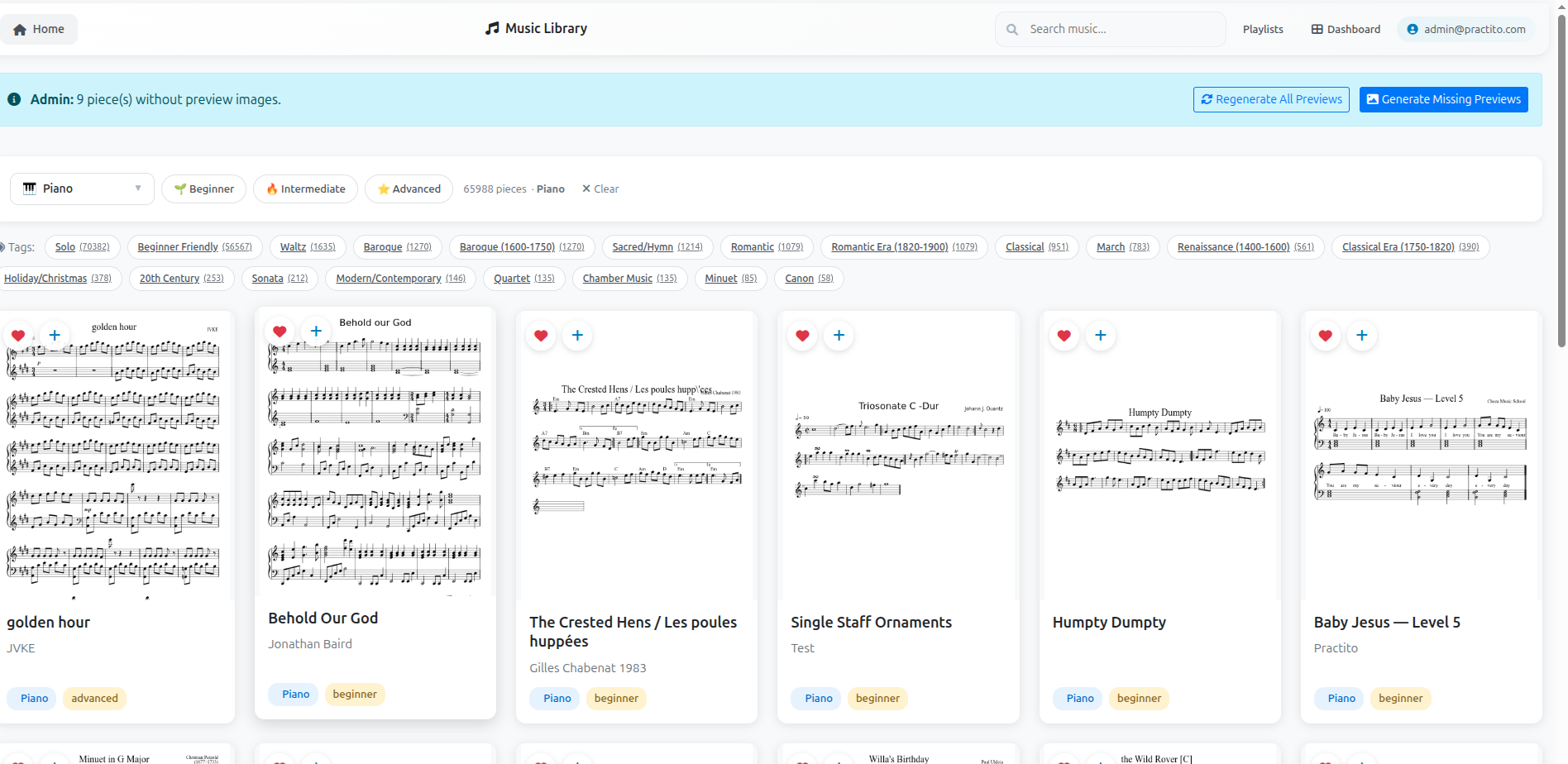
Practito's free music library includes interactive MusicXML versions of many of these pieces — playable at any tempo, with individual sections loopable and BPM targets settable per piece. Browse the beginner piano collection to see what is available, and use the Practice Assistant to structure each session with warm-up scales before moving to repertoire.