The Gap Between Lessons
Most music students have one lesson per week. That leaves six days in which a teacher has no direct visibility into what is happening at the instrument. Students practise inefficiently, practise the wrong things, or — more commonly than any teacher likes to admit — do not practise at all.
The result is predictable: the first ten minutes of every lesson becomes a diagnostic session, identifying what broke down during the week. That is ten minutes not spent teaching. Across a studio of 20 students, it adds up to more than three hours of lesson time lost per week to problems that could have been caught and corrected earlier.
Online progress tracking tools close this gap. Here is how forward-thinking teachers are using them.
Practice Logs: The Baseline
The simplest level of tracking is the practice log: date, duration, what was practised. Even a paper notebook shared between teacher and student improves accountability, because the act of writing forces a student to reflect on what they did.
Digital practice logs go further. When a student logs a session in an app, the teacher can review it before the lesson — not during. Walking into the room knowing that a student practiced 4 times last week (averaging 22 minutes per session) versus not at all changes the entire lesson dynamic. The teacher can prepare appropriately and spend the lesson time on teaching, not fact-finding.
Repertoire Tracking: Knowing What Is Being Practised
Knowing a student practised for 30 minutes is useful. Knowing they spent 20 of those minutes on the wrong section of the wrong piece is more useful.
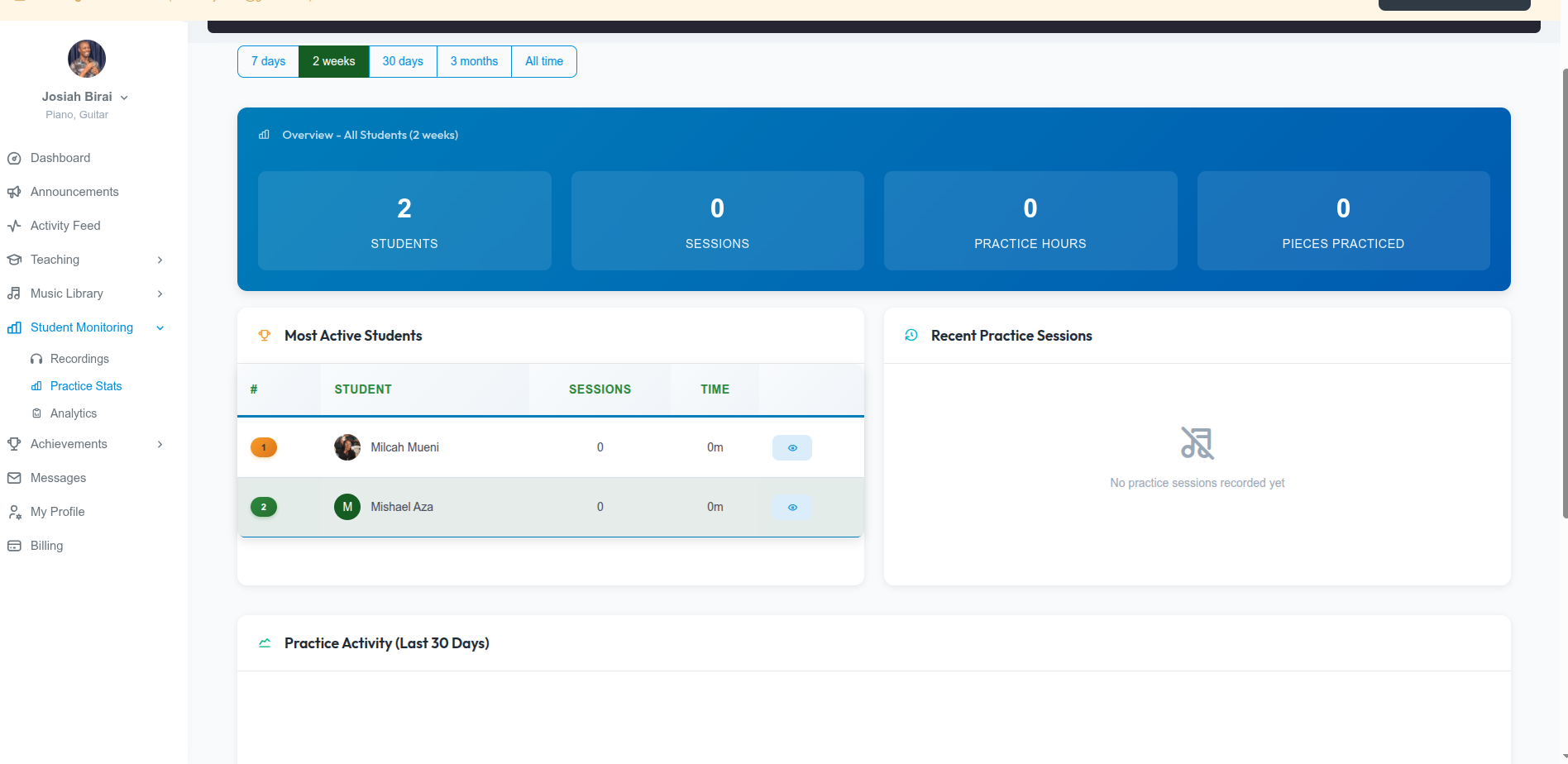
Platforms like Practito let teachers assign specific pieces from the music library — or upload their own MusicXML files — to individual students or entire classes. When the student opens a practice session, the assigned repertoire is already queued. The platform tracks which pieces were opened, how long was spent on each, and at what tempo the student was working.
For teachers managing a large studio, this level of visibility is transformative. Before a lesson with a student working on a Bach Minuet and a Bartók piece, you can see at a glance that they spent four sessions on the Bartók and opened the Bach once. No guesswork about which piece to prioritise.
Tempo and Technique Data
The most granular — and most valuable — data a tracking tool can provide is tempo progression. When did the student first attempt this piece? What BPM were they working at then? What BPM are they at now? How many sessions did it take to add 20 BPM?
This data does two things: it motivates students who can see concrete improvement over time, and it flags students who have been stuck at the same tempo for three weeks (a common signal that the fingering or posture issue has not been resolved and needs teacher intervention).
Practito's analytics dashboard gives teachers a per-student, per-piece tempo progression chart, updated automatically after each session. No manual data entry required.
Video Submissions for Virtual Teachers
For teachers who work entirely or partly online, video submissions have become a standard part of the teaching workflow. Asking students to record and upload a short clip of their practice — not a polished performance, but a working run-through — gives the teacher a direct window into the quality of practice happening between sessions.
This works particularly well for technique issues: embouchure in wind players, bow arm in strings, hand position in pianists. These are difficult to diagnose reliably from verbal description alone. A 90-second video of the student playing a scale tells you more than a five-minute verbal exchange about how the practice is going.
Automated Parent Reporting
For teachers working with children aged 6–14, parent communication is a significant part of the job. Parents want to know whether their child is practising and whether they are making progress. Answering this question individually for 20 families per week is not scalable.
Automatic weekly digests — generated from practice log data and sent directly to parents — solve this completely. A parent receives an email showing that their child practised 4 times last week for a total of 55 minutes, worked on three assigned pieces, and improved their Für Elise tempo from 72 to 84 BPM. No teacher time required. Parents stay informed and engaged, and students (who know their parents receive the report) are more motivated to complete their practice.
Practito handles this automatically for teachers on the studio plan: parents receive weekly summaries and can review their child's practice history at any time through a read-only parent portal.
Setting Up Your Studio for Online Tracking
Getting started takes less time than you might expect. On Practito, the workflow is:
Start a free teacher account — the first class and five students are free, no card required.